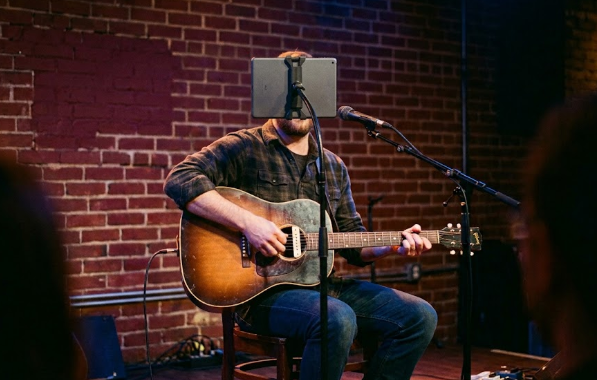
Yes, but only if you set it up like a piece of stage equipment rather than like a phone you happened to bring along. That distinction is the whole article, because almost every horror story about tablets on stage comes down to somebody treating it as the latter.
What the tablet genuinely wins
Start with the honest case for it, because it is stronger than the traditionalists admit.
Capacity. A three-ring binder holds perhaps eighty songs before it stops being portable. A tablet holds every song you have ever learned, plus the ones you half-know, plus the ones somebody requested once. For a solo player filling three hours in a room where requests happen, that is not a small difference.
Search. Somebody asks for a song at the bar. With a binder you are flipping through plastic sleeves in dim light while they watch. With a tablet you type three letters and it is on the screen. Handling a request smoothly is worth actual money in tips and rebookings.
Wind. This is the one that converts patio players. Paper on an outdoor stand is at the mercy of the first gust, and there is no dignified way to chase a setlist across a restaurant terrace. A tablet simply does not care.
Its own light. Bars are dark. A backlit screen means no clip light, no extra power lead, and no squinting at a lyric you only half-remember.
What actually goes wrong
Now the failure modes, in roughly the order they bite people.
The screen sleeps. This is the classic, and it happens in the second verse of the second song. Auto-lock is on by default and it does not know you are looking at it, because you are holding a guitar with both hands. Turn auto-lock off entirely before the gig. Not to five minutes, off.
Something pops up. A notification, a call, a low-storage warning, an update prompt sliding over the chorus. Airplane mode solves nearly all of it at once, and you do not need a network to read a lyric sheet.
The battery. A screen running at full brightness for three hours is a heavier load than casual use, and the number you remember from browsing at home is not the number you will get on stage. Know your real runtime, arrive fully charged, and keep a power bank in the gig bag.
Daylight. This is the genuine weakness and it deserves a straight answer: on a bright patio at four in the afternoon, a tablet is harder to read than paper. Full brightness helps and costs you battery, and an anti-glare screen protector helps a little more. But this is the one scenario where paper still wins outright, and pretending otherwise will cost you a set.
The physical stuff. Rain and humidity on outdoor gigs. Drinks at elbow height in a bar. A tablet is a several-hundred-dollar item sitting unattended on a stand during your break, which a binder is not. And auto-rotate will flip your screen sideways the first time somebody knocks the stand, so lock the orientation.
The setup that makes it reliable
- Airplane mode on, auto-lock off, rotation locked. Three switches, thirty seconds, and they eliminate most of the list above. Make it part of your setup routine, in the same breath as tuning.
- A real mount. A tablet holder that threads onto a mic stand is far more stable than a slab balanced on a wire music stand, and it puts the screen where you actually look rather than forcing your head down.
- A Bluetooth page turner. AirTurn and PageFlip both make pedals for this. Your hands stay on the guitar and you stop breaking the song to swipe, which is the single biggest visible improvement over a binder.
- An app built for the job. OnSong, forScore or UnRealBook, rather than a photo album full of screenshots. They handle setlists, transposition, annotation and pedal input properly, and transposition alone will save you the night a singer wants something a tone lower.
- Paper for the ones you cannot fake. Ten sheets in the gig bag covering the songs you would be stuck on. It weighs nothing and it means a dead tablet ends your convenience, not your set.
The objection worth taking seriously
The real criticism is not technical. It is that a player reading a screen is a player looking down, and an audience can tell the difference between someone performing and someone reciting.
That is a fair complaint, but it applies just as much to a binder. The format is not what makes somebody bury their face in the words. The fix is the same either way: know the material well enough that the screen is a safety net rather than a script. Set the font large enough to read at a glance from playing position. Fit each song on one screen so you are never scrolling mid-verse. If you find yourself reading every line of a song you have played two hundred times, the problem was never the tablet.
By the room
Senior communities: yes, comfortably. The repertoire is broad and request-driven, which is exactly what a searchable library is for. Large font, and a stand low enough that you are not hidden behind it.
Bars at night: yes. Dark rooms are where the backlight earns itself, and nobody is close enough to care what you are reading from.
Daytime patios: the hard case. Wind favours the tablet and sun favours the paper, and which one wins depends on whether your spot is shaded. If you play a lot of bright afternoons, keep the paper option genuinely ready rather than theoretically ready.
Listening rooms and private events: yes, but discreetly. Low stand, dim screen, and know the set well enough that you barely glance at it.
So: yes. The tablet is better than the binder at nearly everything a working solo player needs, and the ways it fails are all preventable with a few minutes of setup. Just do not let the first time you think about auto-lock be the second verse of the second song.