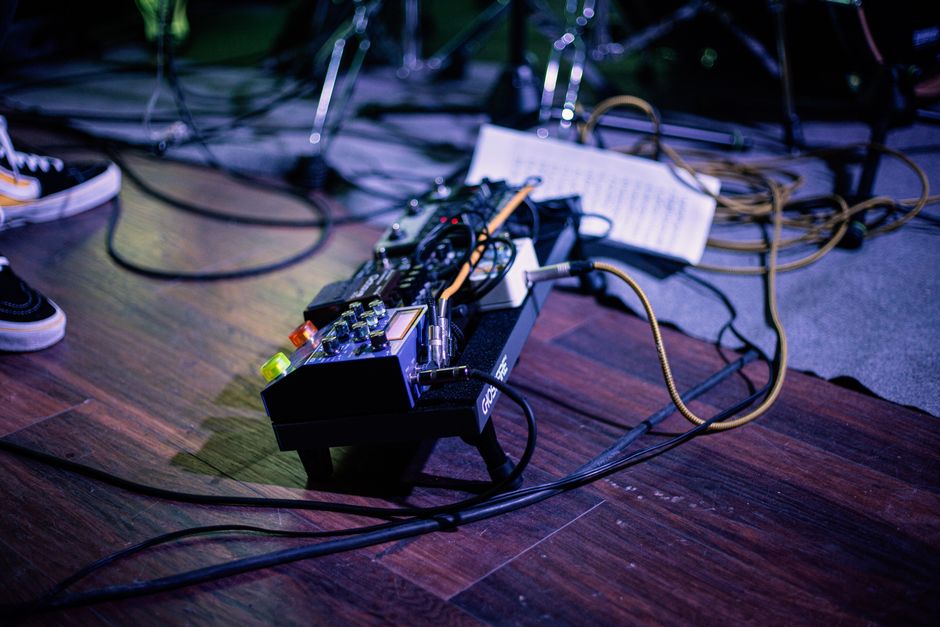
Almost every acoustic DI pedal sells itself on its tone controls. Bass, mid, treble, maybe a sweepable midrange if you spend a bit more. The L.R. Baggs Session DI does not have any of that, and understanding why is the whole point of the pedal.
No EQ, on purpose
Instead of an equalizer, the Session DI shapes your sound with analog saturation and multiband compression. Those two controls are doing the work that a tone stack would normally do, and they do it differently.
An EQ is subtractive and surgical: you find the frequency that offends you and you turn it down. Saturation and multiband compression are neither. Saturation adds harmonic content that was not there before, which is what people mean when they say a signal sounds warm rather than merely loud. Multiband compression evens out the dynamics separately across frequency ranges, so a hard-picked bass note stops jumping out without dragging the whole signal down with it.
The name is a clue to where this came from. L.R. Baggs built the Session around the kind of processing an engineer would put across an acoustic track in a studio, and then reduced it to controls you can set with your hands full. What you gain is texture and depth that an EQ genuinely cannot produce. What you give up is precision. If you need to notch out one specific ugly frequency, this is not the tool that does it.
Except for the frequencies that make it howl
There is one exception, and it is the reason this pedal is built for stages rather than desks. Feedback gets its own dedicated set of controls, separate from the tone-shaping entirely.
- A variable Garrett Null notch filter, for finding the single frequency where a hollow wooden box in front of a speaker decides to sing on its own.
- A phase switch, which is often the fastest fix in the room and costs nothing to try.
- A variable highpass filter at 40, 80, 120 or 200 Hz, for cutting the low-end rumble that a stage floor pumps into the guitar body.
Set the highpass as high as you can stand before the guitar starts sounding small. On a boomy patio with a subwoofer nearby, 120 Hz will often clean up a problem that no amount of turning down would fix.
The VU meter is not decoration
The Session DI has a VU meter for setting input gain, and it is more useful than it first appears. Pickup output varies enormously between instruments, and a preamp fed too little signal produces a thin, noisy result while one fed too much produces distortion nobody asked for.
The meter turns that from guesswork into thirty seconds of setup. It also means the saturation control behaves consistently, because saturation is level-dependent by definition: set the gain properly and the sound you dialled in at home is the sound you get at the gig.
Built to hand to a sound engineer
The output section is where the “DI” in the name earns itself. There is a balanced XLR out for the house desk alongside a quarter-inch out for an amp, so you can feed both at once. A ground lift switch deals with the hum you get when the stage and the desk disagree about earth, which on an old bar’s wiring is not a rare event.
There is also a mute footswitch, which is the small feature that quietly matters most. It lets you tune, swap instruments or retune a string between songs in complete silence instead of doing it through the PA, the same twenty seconds of dead air, minus the audience hearing every bit of it.
Power is flexible in a way that solves real problems: phantom power from the desk, a 9V battery, or an external supply. Phantom power is the one to note. If you turn up somewhere with no accessible outlet, say a patio corner, a marquee, or a room where the only power is thirty feet away, a pedal that runs off the same XLR cable that carries your signal is one less thing to negotiate.
Or the cheaper one
The Session DI runs around $269. L.R. Baggs also makes the Align Session at roughly $179, and the difference is worth spelling out because the core is the same: the Align Session takes the saturation and compression directly from the Session DI in a smaller enclosure.
What the Align Session leaves out is everything in the two sections above: the XLR output, the highpass filter, the phase switch and the notch filter. In other words, it keeps the tone and drops the stagecraft. It is also more flexible about placement: with no DI stage forcing it to the end of the chain, you can put it anywhere on a board.
So the decision is fairly clean. If you already own a DI, or you play through your own amp and never hand anything to an engineer, the Align Session gets you the sound for ninety dollars less. If you turn up at venues, plug into somebody else’s desk and have to solve feedback yourself, the Session DI is the one that carries the tools for it.
Specifications and pricing come from L.R. Baggs’ published product information and Sweetwater’s listing, checked in August 2026; the Align Session comparison draws on L.R. Baggs’ own forum guidance. Prices change. Confirm before buying. This is an explainer built from published specifications rather than a long-term hands-on review, and it is written that way deliberately.