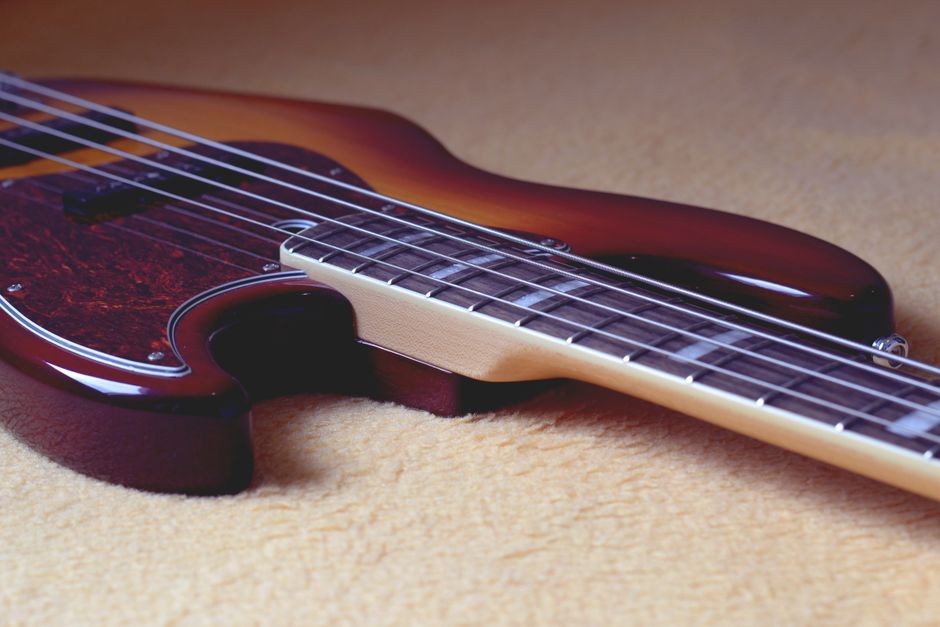
Every time someone asks me why one guitar feels great and another feels like wrestling a two-by-four, the answer is almost never the brand or the price. It is two specs most players never look up: nut width and neck profile. I have set up enough kitchen-table guitars, from pawn shop Yamahas to a couple of Martins that were worth more than my car, to say this with confidence. Body size and tonewood get all the attention in reviews. These two numbers are what your left hand actually feels, note to note, all night.
Nut width is the easy one to compare because it is a real measurement, not a feeling. Martin has built its steel strings around two standard widths for decades: 1-11/16 inches and 1-3/4 inches, the wider spec showing up on their 12-fret and classical-leaning models. That eighth of an inch does not sound like much until you are playing a barre chord on a humid night in a bar with no air conditioning. A narrower nut, like the 1-11/16 you get on most modern Martin dreadnoughts and a lot of Taylors, puts the strings closer together, which favors fast single-note runs and smaller hands. A wider nut spreads the strings out, which favors fingerstyle players who need room for the thumb and three fingers to not collide, and it is why classical guitars sit even wider still, usually around 2 inches. On the electric side the numbers run narrower across the board; Fender lists the nut on a modern American-made Stratocaster at 1.685 inches, which is why a player moving from an acoustic dreadnought to a Strat often feels like the strings have bunched up under their fingers even though nothing about their technique has changed.
Neck profile is the shape of the back of the neck, and it is where people get vague because it is described in words instead of numbers, terms like C, D, V, or soft V. This is the tradeoff nobody explains well. A slim C profile, the kind Fender puts on a lot of its modern electrics and some travel acoustics, feels fast and easy to wrap your hand around, especially for players coming from thinner electric necks. But that same thin profile can feel flimsy and tiring on a full night of open chords, because your hand has less to rest against and ends up gripping harder than it needs to. A fuller D or soft V, the kind you find on older Gibsons and a lot of vintage-reissue acoustics, fills your palm and lets your thumb anchor without effort, but it is genuinely harder to get your hand around for fast lead work or big stretches. Gibson’s own spec sheets put real numbers on this: a ’50s Rounded neck measures close to .85 inches deep at the first fret, while their ’60s SlimTaper profile comes in nearer .80 inches at the same spot, and that difference of a few hundredths of an inch is what separates a neck that feels like a baseball bat from one that disappears in your hand.
There is an edge case the C-versus-D framing does not cover, and it is worth knowing about before you get frustrated with a neck that measures fine on paper but still feels wrong. Some builders now shape the neck asymmetrically, thicker under the bass strings and thinner under the treble strings, so a thumb-over-the-top player gets support without the whole profile feeling bulky. Ernie Ball Music Man uses this on several of its signature models, and it is a completely different feel from a symmetrical D even at the same average depth. On the opposite extreme, Ibanez built its reputation on the Wizard neck, a profile so thin and flat it is closer to a slab than a taper, aimed squarely at players doing fast legato runs who never plant a thumb on the back of the neck at all.
Here is how I actually choose, and how I tell people to choose. If you are a strummer or a singer-songwriter who plays rhythm all night and wants your hand to survive four sets, go wider nut, fuller profile. Your hand will thank you at midnight even if it feels a little clunky in the store at 2pm. If you are a lead player, a fingerpicker doing fast alternating patterns, or you just have smaller hands, go narrower nut, slimmer C profile. Neither one is correct in some abstract sense. They solve different problems.
The only real trap is buying by spec sheet alone. Nut width and profile interact, so a 1-3/4 inch nut with a slim C can feel completely different from the same width with a full D. Scale length and fretboard radius pile on top of that, which is why two guitars with identical nut width and profile numbers can still feel like different instruments in your hand. Go play both in person if you can, at a real store, not off a chart. But now you will know which two numbers to ask about, and why the guitar in your hands feels the way it does.