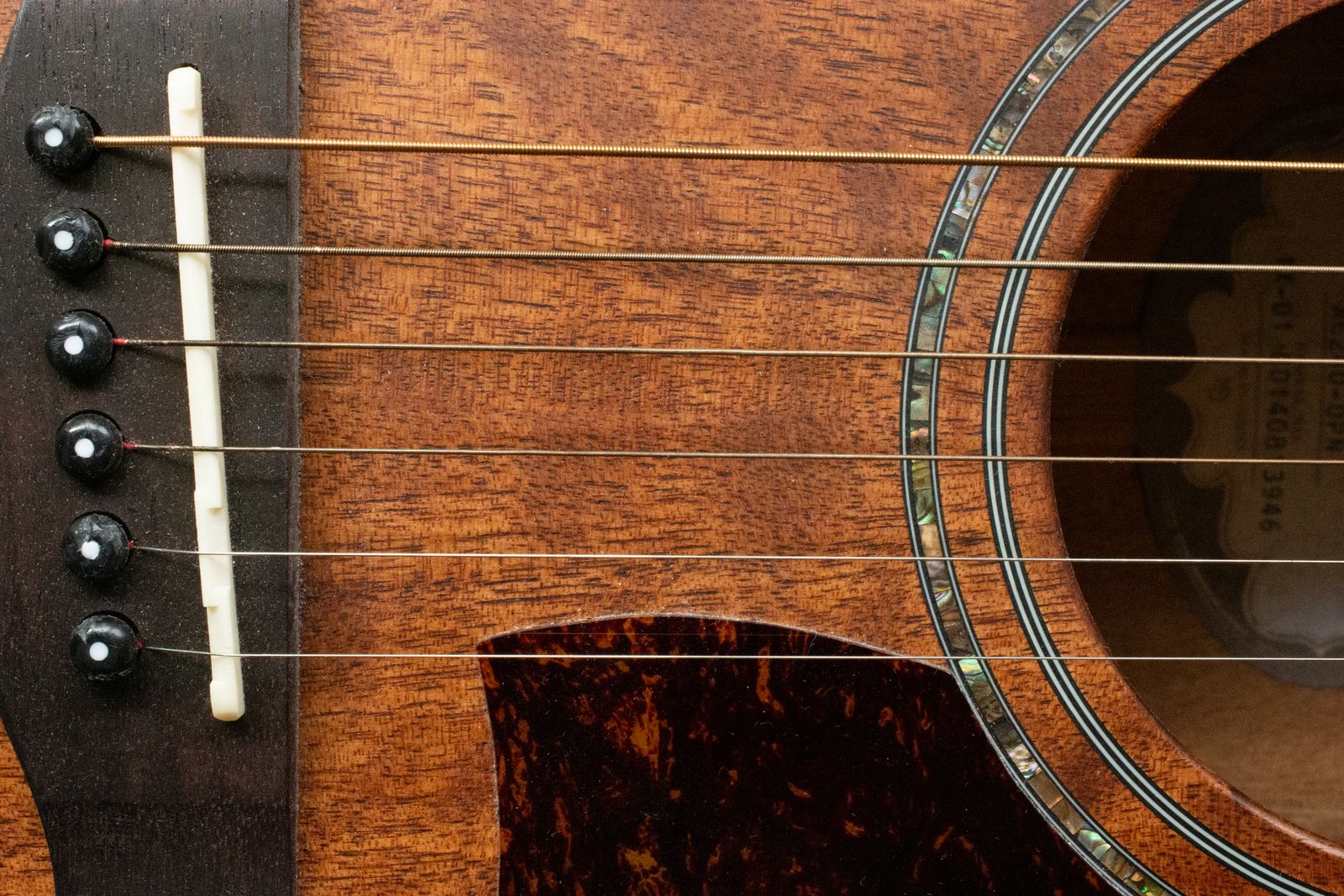
The acoustic string wall is a bad place to make a decision. Twenty near-identical packages, all promising warmth and brightness in the same breath, and no way to try one. But the choice collapses into two questions that have nothing to do with tone woods or marketing copy: what alloy is wrapped round the core, and how often do you actually pick the guitar up?
The alloy is the real fork in the road
Every standard acoustic set has a steel core. What differs is the wrap wire on the four wound strings, and there are only two mainstream answers.
80/20 bronze is 80% copper, 20% zinc, brass, in other words, whatever the package calls it. It is bright and crisp, with a scooped, glassy top end. It is also the shorter-lived of the two: that zinc-heavy alloy oxidizes fast, and the sparkle you paid for is measurably gone within a couple of weeks of regular playing.
Phosphor bronze adds a small amount of tin and a trace of phosphorus to the copper. D’Addario introduced it for guitar strings in 1974, and the phosphorus is there specifically to slow corrosion. The tonal result is warmer, with more midrange and less of the initial glassy attack. The practical result is a set that holds its character noticeably longer.
The honest summary: 80/20 sounds better than phosphor bronze on day one, and worse than it on day twenty. Which of those two days matters more to you is genuinely a preference, not a mistake.
Coated strings are a math problem, not a tone problem
Coated sets, such as Elixir’s Polyweb and Nanoweb, D’Addario XT, and Martin Lifespan, wrap the string in a thin polymer that keeps skin oils and grime out of the windings. That is the entire mechanism. Strings do not die because the metal wears out; they die because the gaps between the winding wraps fill up with corrosion and dead skin, which kills the highs and ruins intonation.
The tradeoffs are real and worth naming plainly:
- They cost roughly two to three times as much per set.
- They last several times longer before going dull, so per week of decent tone, they are usually the cheaper option, not the more expensive one.
- They give up some brightness and some sustain. The coating damps the string slightly. Polyweb is the thicker, slicker, more obviously damped of Elixir’s two; Nanoweb is thinner and keeps more top end.
- Less finger squeak on position shifts, which matters more when recording than it does in a room.
So the decision is about frequency, not taste. If you play most days, uncoated strings spend most of their life sounding good and coating buys you comparatively little. If the guitar comes out twice a month, an uncoated set is stale before you have played it in and coated strings are the obvious buy. And if you have acidic sweat, you will know because you kill a set in two weeks while your friend gets three months, coated strings stop being a preference and start being the only thing that works.
Gauge changes the guitar, not just the strings
Acoustic sets are named by the diameter of the top E in thousandths of an inch:
- Extra light, .010-.047: easiest to fret, thinnest sound, prone to buzzing under a heavy pick.
- Custom light, .011-.052: the sensible default on small-bodied guitars and for anyone whose hands are complaining.
- Light, .012-.053: what most dreadnoughts ship with and what most guitars are set up around.
- Medium, .013-.056: more volume and more push behind a flatpick, at the cost of real effort under the fingers.
Here is the part the package does not tell you: a gauge change alters the total tension pulling on the neck, so the guitar you get back is not set up the way it was. Going up a gauge adds bow, raises the action and can pull the intonation sharp. Going down removes bow and invites buzz. Expect to re-check the relief afterwards, see the setup walkthrough for the measurements, and treat any comparison between two gauges as unfair until you have.
Older or lightly-built instruments are a special case. If a guitar is small-bodied, vintage, or has any bridge lifting, mediums can do structural damage. Silk and steel sets exist for exactly this: much lower tension, mellow and quiet, and kind to a guitar that should not be strung tight.
What to actually buy
- Playing most days, strumming, want value: uncoated phosphor bronze, light gauge. Change them often; they are cheap.
- Recording, or chasing a bright modern jangle: 80/20 bronze, fitted fresh the day before, and accept the short life.
- Occasional player, or a gigging guitar you cannot restring weekly: coated phosphor bronze. The premium pays for itself.
- Fingerstyle, small body, or a fragile old guitar: custom light, or silk and steel if the instrument is genuinely delicate.
Then stay put for a year. Strings are the one variable on a guitar that is cheap enough to fiddle with endlessly, which is precisely why so many players never learn what any of them sound like.