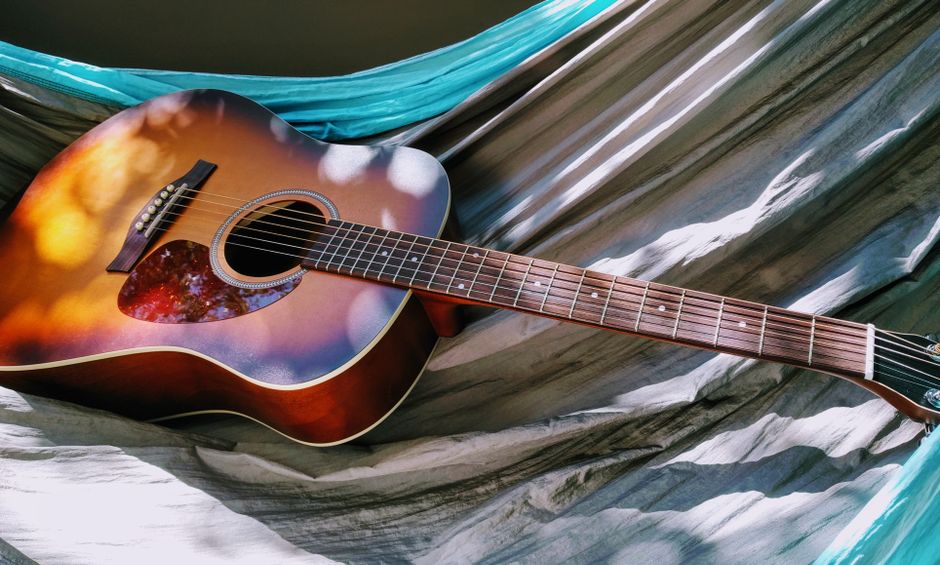
The dreadnought isn’t even monolithic once you start comparing across brands, and that’s a caveat worth knowing before you assume “dreadnought” means one sound. A Martin D-18, with its square shoulders and scalloped bracing, is voiced differently than a Gibson J-45, which has sloped shoulders and has been Gibson’s workhorse flattop since it was introduced in 1942. The slope-shouldered design trades some of that scooped, boomy low end for a more compressed midrange, which is part of why the J-45 shows up on so many recordings where the guitar needs to sit inside a mix rather than dominate it. So even if you’ve decided a dreadnought is right for you, the shoulder shape and bracing inside that broad category still change what you’re getting, and it’s worth playing a square-shouldered and a slope-shouldered version back to back before you commit.
There’s also a shape that splits the difference between a dreadnought and a concert, and it doesn’t get mentioned nearly enough at the counter: the OM, or Orchestra Model. Martin built the first ones in 1929 at the request of Perry Bechtel, a banjo player who wanted a flattop with a 14-fret neck so he could play up high the way he did on banjo, and the OM was the guitar that established that longer, more guitar-like neck joint industry wide. Body-wise it sits between a 000 and a dreadnought, narrower waist than a dreadnought, but a touch more low end and volume than a 000, which makes it a genuine middle option for someone who flatpicks single-note runs as often as they strum chords. If you’ve tried a dreadnought and a concert and neither one quite fits, the OM is worth adding to that lineup before you write off the whole idea of a “middle” guitar as a myth.
None of this means bigger or smaller is better in some absolute sense. It means the shape changes what the guitar rewards you for doing. A dreadnought rewards a heavy strumming or flatpicking hand and gives you volume without much effort. A grand auditorium rewards touch and note separation. A concert or 000 rewards a light hand and close listening, the kind of playing where you’re chasing tone more than volume. An OM rewards someone who moves between rhythm and lead in the same song and doesn’t want the body fighting them either direction. None of these are upgrades or downgrades from each other. They’re just tuned for different jobs, the same way a Telecaster and a Les Paul aren’t better or worse versions of “electric guitar,” just different tools for different attacks.
Every guitar store clerk has told some version of the same story: get a dreadnought first, that’s the “standard” shape, you can grow into it. I believed that too for a long time, and I sold my share of dreadnoughts to beginners across the counter before I ever ran my own repair table. It’s not terrible advice, but it’s not really advice at all. It’s a default setting, and defaults get chosen for reasons that have nothing to do with how you play.
Here’s the myth: that dreadnought equals normal, and everything else is a specialty shape for people with specific needs. The truth is closer to the opposite. The dreadnought itself was a specialty shape when it showed up: the first ones weren’t even Martins, they were built for the Oliver Ditson Company starting in 1916 and sold mainly around New York and Boston, with 12-fret necks and sloped shoulders rather than the squared shoulders that came later. It became “standard” because bluegrass and country flatpickers needed to cut through a band with no PA, not because it’s the correct shape for guitar in general. If you’re playing solo fingerstyle in a living room, that history doesn’t apply to you.
What actually matters is where and how you play. I’ve gigged dive bars for thirty years, mostly plugged into a cheap PA that can’t be trusted to do you any favors, and for that work a dreadnought or its slightly smaller cousin still earns its keep: big low end, strong midrange punch, forgiving under a hard flatpicking or strumming hand. My main stage guitar for years was a Martin D-18 clone, and it does exactly one thing extremely well: get loud without falling apart.
But at the kitchen table, doing setups on other people’s guitars, the ones that make me want to sit and noodle for twenty minutes after I’m done are almost never dreadnoughts. They’re grand auditorium shapes: the Taylor 814ce and its siblings, or similarly sized guitars from other builders. Bob Taylor drew up the Grand Auditorium in 1994, and it’s been Taylor’s most popular shape ever since for a simple reason: the mid-size body and tapered waist give you clear, well-defined notes instead of a wall of low end. That balance is the point: less boom, more definition across the whole neck, which matters if you’re playing chord-melody or fingerpicking where you need the bass notes to not swallow everything else.
Concert-size bodies (or the 00 and 000 shapes from Martin, or similarly compact guitars from Guild and Gibson) go a step further toward focus over power. Smaller lower bout, quicker note decay, less low-end sprawl. If you sit down and play by yourself, or you record a lot at home where a mic can make up for what the body doesn’t, a concert or 000 will often feel more responsive under your fingers than a dreadnought does, even though it measures “less guitar” on paper.
So don’t ask which shape is standard. Ask what you actually do most: strum in a loud room, fingerpick alone, record close-mic’d, or flatpick lead lines. Go play a dreadnought, a grand auditorium, a concert or 000, and an OM back to back, same strings, same store, and pay attention to which one you keep reaching for after the sales pitch ends. That’s the shape that’s right for you, not whichever one sits closest to the door.