Every few months somebody at a gig asks me to show them “that fancy fingerpicking thing” and points at my right hand like it’s doing something complicated. Most of the time it isn’t. The myth I want to knock down is the idea that impressive-sounding fingerstyle comes from your fingers moving fast or doing something intricate. It doesn’t. It comes almost entirely from what your thumb is doing while your fingers do almost nothing.
I learned this the slow way, playing bar gigs for twenty-some years and filling dead air between songs with picking patterns because a full band break was too abrupt. Audiences reacted the same way every time to a pattern that sounded busy but was really just a steady bass with two notes dropped on top. Nobody in a bar is transcribing your right hand. They’re hearing a groove.
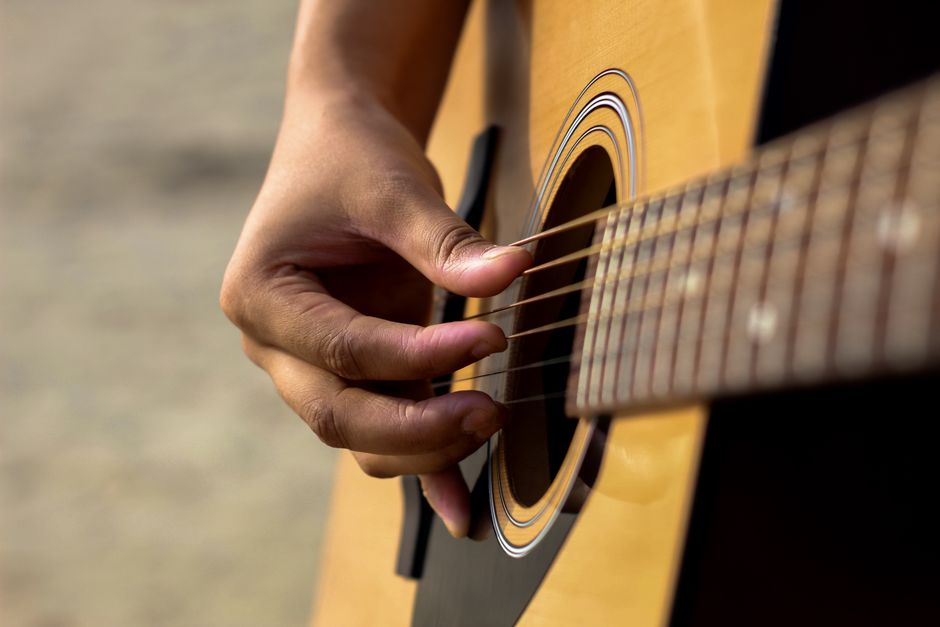
The technique behind almost all of this is Travis picking, named for Merle Travis, though most people know the sound from Chet Atkins or Tommy Emmanuel records. The whole idea is deceptively simple: Merle developed a way to imitate stride piano on guitar by playing melody and an alternating bass line at the same time using his index finger and thumb. That’s it. The thumb alternates between two bass strings, usually the root and the fifth of the chord, on a steady quarter-note pulse, and your fingers just pick out two or three notes from the chord shape on top, usually on the off-beats. The bass line is doing the work of sounding busy. Your fingers are barely moving.
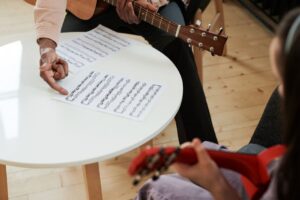
Where people go wrong is starting with the fingers. They try to learn a pattern by memorizing which finger hits which string in what order, treating it like a drum pattern to be counted out. That’s backwards and it’s why the pattern falls apart the moment you try to add it under an actual song. Instead, isolate the thumb first, on a muted string if you have to, until the alternating bass feels as automatic as tapping your foot. I’ve had players on cheap guitars at my kitchen table get this solid in fifteen minutes once they stop trying to think about their fingers at all. Only after the thumb runs on its own do you drop the top notes in. If you’re counting all six notes as one pattern, you’re carrying a mental load you don’t need.
A related myth: that you need bare-finger precision to make this sound clean. On a lot of dreadnoughts and cheap laminate guitars, a bare thumb gets buried in the low end and the whole pattern turns to mud. A cheap fix that actually matters here is a thumbpick. Fred Kelly’s Speed Picks run under two dollars each and give the thumb enough attack to cut through without you having to dig in and throw off your dynamics. I keep a handful in my case for students who show up with instruments where the bass strings are voiced too heavy for bare-finger picking to read clearly. If a student’s hands are small or the Fred Kelly shape feels awkward against their thumbnail, I’ll point them at a Dunlop Primetone thumbpick instead, which runs a few dollars more but has a rounder edge that some players find sits better without catching on the string on the upstroke. Either one beats fighting a bare thumb on a guitar with heavy bass strings.
This changes on a nylon-string classical guitar, where almost nobody uses a thumbpick. The strings are lower tension and the plastic-and-nylon combination sounds thin and clacky compared to a bare thumb doing a proper rest stroke into the string. If a student brings a classical guitar to the table, I have them drop the thumbpick and work on planting the thumb and letting it fall through the string instead, which is a different motion than the free stroke most steel-string pickers default to.
The pattern that gets the most mileage for the least actual difficulty is what’s sometimes called the “PIMA constant bass” pattern: thumb alternates root-fifth-root-fifth in quarter notes, fingers pick the top two strings of the chord on beats two-and and four-and. Put that under a I-IV-V progression in open G or C and it sounds like you’ve been playing fingerstyle for years. I’ll usually have a student start it at 60 beats per minute on a metronome, thumb only, and not let them add the top notes until they can hold that tempo for a full minute without the beat wobbling. Push it up to 90 or so once it’s automatic and it starts to sound like the kind of thing you’d hear under a song like Kansas’s “Dust in the Wind,” which is really the same alternating-bass idea dressed up with a fuller chord voicing. You haven’t been playing fingerstyle for years. You’ve just gotten your thumb out of your head and onto autopilot, which is the whole trick.