There is a particular kind of dead air that happens on a patio gig. You have finished a song, the applause has run out, and you are hunched over the guitar picking one string at a time while forty people watch you not play anything. Twenty seconds of that feels like a minute.
That gap is the problem the TC Electronic PolyTune Clip was built to close, and it is worth understanding what it does and does not solve before you spend anything on one.
What polyphonic tuning actually does
Strum all six strings and the display shows you all six at once. That is the whole idea. Instead of walking the tuner down the neck string by string, you get an instant readout of which strings drifted and which are fine.
The important thing to understand is that polyphonic mode is a triage tool, not a precision one. It answers “which string do I need to deal with”, not “is this string exactly right”. Nine times out of ten on a gig, the answer is that one string moved and the other five are fine, and knowing that immediately is the difference between a four-second adjustment and twenty seconds of silence.
Three modes, and which one you will actually use
TC Electronic gives the Clip three tuning modes, and the specifications are worth reading carefully because the headline number is the least useful of the three.
- Polyphonic. All six strings at once, as above. This is the mode that justifies the purchase.
- Chromatic, ±0.5 cent. One string at a time, the way every other clip-on tuner works. Half a cent is far finer than anyone can hear.
- Strobe, ±0.02 cent. The number that appears in every advertisement for this tuner.
Be honest with yourself about that last figure. A cent is one hundredth of a semitone. Trained ears start detecting pitch differences somewhere around five cents, and a wooden instrument sitting on a warm patio will drift further than 0.02 cents while you are reading the display. On a gig, strobe mode’s precision is decoration.
Where it genuinely earns its keep is at the bench and in front of a microphone: setting intonation at the saddle, checking a nut slot, or tuning for a recording where two takes have to sit on top of each other without beating. If you do that work, strobe mode is a real feature. If you play bars, it is a number on a box.
The display is the underrated part
Clip-on tuners fail outdoors. That is the category’s oldest weakness: a dim display that is perfectly legible in a living room washes out completely at four in the afternoon on a sunlit patio, which is exactly where a lot of solo acoustic work happens.
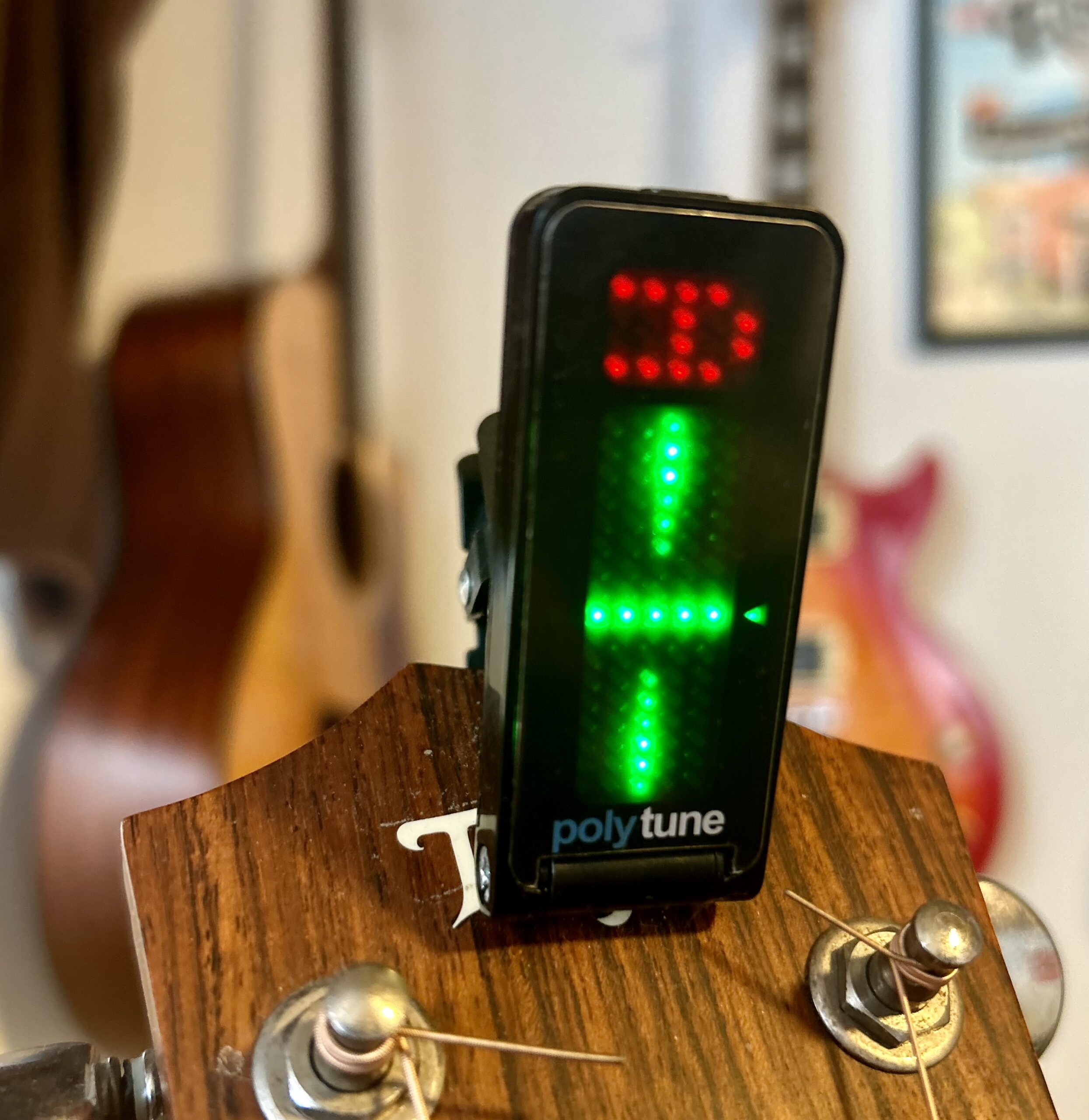
The PolyTune Clip answers this with a 108-LED matrix rather than a conventional screen, and brightness is the practical reason to prefer it over cheaper clip-ons. The display is also adaptive: it senses its own orientation and flips so it reads correctly whether you clip it to the front or the back of the headstock, and whether you play right- or left-handed. That sounds like a gimmick until you have owned a tuner that forced you to mount it somewhere awkward to read it.
Build, battery and the one real complaint
The clip is stainless steel rather than the moulded plastic that snaps on cheaper units after a season of being thrown into a gig bag. Power is a single CR2032 button cell, included, which is the standard for the category and easy to carry a spare of.
The limitation worth knowing about before you buy is the hinge. Reviewers at Guitar World noted that the clip folds out in one direction only and does not pivot on multiple axes the way some competitors do. In practice most players find an angle that works and never think about it again, but if you have an unusual headstock, a slotted classical, or something with an aggressive back angle, it is the specification to check first.
What it costs, and the cheaper sibling
Sweetwater currently lists the PolyTune Clip at $37.90, which puts it above the ten-dollar clip-ons and below a pedal tuner. TC Electronic also makes the UniTune Clip, which shares the bright display and the build but drops polyphonic mode for roughly a third less money.
That comparison is the actual buying decision. The extra money buys you polyphonic tuning and nothing else of consequence. If you play sitting down, alone, with time between songs, the UniTune does the same job. If you tune in front of people and every second of silence is yours to fill, the polyphonic mode is worth the difference. It is the one feature on this tuner that changes what happens on stage rather than what appears on the display.
Who should skip it
If your guitar already goes through a pedalboard, buy a pedal tuner instead. It mutes the signal while you tune, which no clip-on can do, and that matters more on a stage than any accuracy figure. And if you play entirely at home, almost any tuner will hold a guitar in tune well enough that you will never hear the difference.
The PolyTune Clip is for the specific case of an acoustic player, in front of an audience, without a pedalboard to hide behind. For that job it is very well judged.
Specifications in this article come from TC Electronic’s published product information and from Sweetwater’s listing, checked in August 2026; the note about the hinge comes from Guitar World’s review. Prices change. Confirm before buying. This is an explainer built from published specifications rather than a long-term hands-on review, and it is written that way deliberately.