For about two years I tuned up before every gig with GuitarTuna on my phone, propped against my amp, and I never once questioned it. The app is good. It is accurate to a cent or two, it is free, and it has a clean interface that does not waste your time. The mistake was not the app. The mistake was where I was using it.
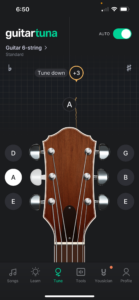 A phone tuner listens through the microphone. That is the whole design. It is built to hear the room, which is exactly what makes it reliable in a quiet kitchen or a practice room with the door closed, and exactly what makes it fall apart in a bar with a PA humming, a drummer warming up, and forty people talking over a jukebox. The app does not know the difference between your B string and the guy two tables over clinking a beer bottle against the bar rail. It just hears pitch information and tries to make sense of it. Most nights it got close enough that I did not notice. A few nights it did not, and I found out when the first chord of the set rang out wrong in front of a room.
The fix is not complicated, and it is not really about the app being bad. It is about matching the tool to the room. At home, on the kitchen table where I do most of my setups and string changes anyway, a phone app is genuinely enough. Concert pitch, A equals 440 Hz, has been the agreed reference since it was formalized in the international standard ISO 16 back in 1975, and any decent tuner app, free or paid, tunes to that reference with real precision when the room is quiet. There is no reason to spend money solving a problem that does not exist in your living room.
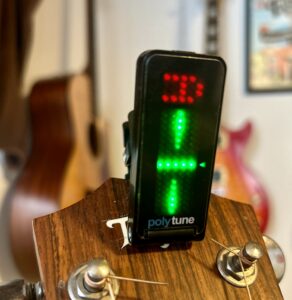
On a stage, or anywhere with ambient noise, you need a tuner that reads the string directly instead of listening through the air. That is what a clip-on tuner does. It clamps onto the headstock and picks up vibration through contact with the wood, not sound through a microphone, so a noisy room does not confuse it. This is the whole reason clip-ons exist as a separate category instead of everyone just using their phone. I wrote more about this in my PolyTune Clip post if you want the deeper rundown on that specific unit, but the short version is that reading vibration instead of sound is the entire advantage, and it is not a small one once you are gigging regularly.
I switched to the TC Electronic PolyTune Clip a few years back after watching too many bands around me squint at phone screens between songs while the room swallowed the readout. It runs about 30 to 40 dollars depending on where you find it, clips on fast, and has a polyphonic mode where you strum all six strings at once and it shows you which ones are off, which saves real time between sets when you do not want to tune one string at a time with people watching. It is not flashy. It does the job the way a tool should.
Where a pedal tuner earns its keep is a different situation entirely, and it is worth being honest about when that is. If you are running a pedalboard already, a tuner pedal like the TC Electronic PolyTune 3 or a Boss TU-3, both around 99 dollars, lets you mute your signal and tune silently through your own rig without unclipping anything or reaching up to your headstock between songs. That matters most if you are doing quick retunes mid-set, dropping to D on one song and back to standard on the next, where a few seconds saved per song adds up over a three hour night. If you only own one guitar and play out once in a while, that is money better spent on strings.
So the real lesson from my own mistake was not “stop using the phone.” It was “stop using the phone in a room that is too loud for it to do its job.” GuitarTuna still lives on my phone and I still use it at home. The PolyTune Clip lives in my gig bag and does not come out until the lights come up and the room gets loud. Different tools for different rooms, and knowing which is which is the whole trick.