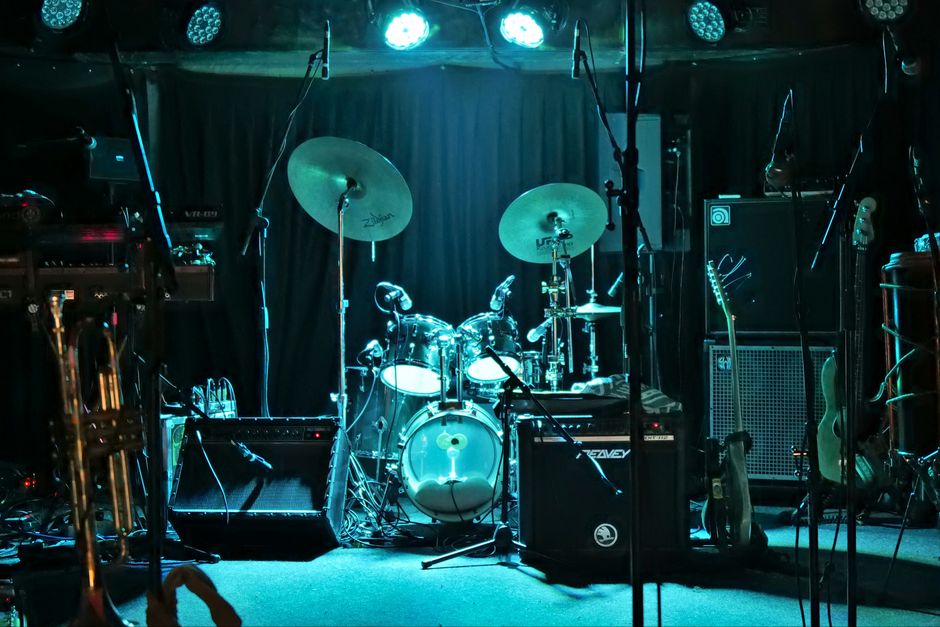
I’ve hauled a lot of gear into a lot of bars, and for years my rig for solo shows was the same as my band rig, just fewer inputs: two powered speakers on tripod stands, a small mixer, cables everywhere, and a monitor wedge if the stage had room for one. It worked. It also took twenty-five minutes to set up and another twenty to tear down, and half the time I was fighting with a speaker angle that either blasted the front row or left the back of the room guessing at the words. Column arrays changed that calculation for me, and I think they’re the right call for most solo players now, though not for every reason people assume.
The traditional approach is two full-range speakers, usually 10, 12 maybe 15 inch tops (If you are real old school), on poles, paired with a mixer and maybe a separate sub if you need low end for a looper or backing tracks. The upside is flexibility. You can angle each speaker independently, add channels as your rig grows, and swap components when one thing dies instead of replacing the whole system. The downside is coverage. A single 12 inch speaker throws sound in a fairly narrow vertical pattern, which is why you end up either standing in a dead zone or blasting whoever’s sitting closest to it. It’s also more to carry, more to set up, and more that can go wrong with cables and stands at 11pm when you just want to load out.
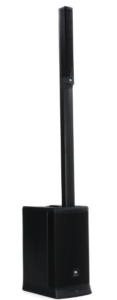
A column array does something different by using several small drivers stacked vertically instead of one big one. That vertical spread lets the array control dispersion in a way a single driver can’t, throwing sound wide across the room horizontally while keeping it from blasting straight up at the ceiling or down at the floor. Sound on Sound’s rundown of column PA systems put it plainly: Column systems are designed for use by solo musicians, singing guitarists and the like, who don’t need a subwoofer for massive bass reproduction.
That’s the case for most acoustic and singer-songwriter gigs. You’re not trying to move air for a kick drum, you’re trying to get a voice and a guitar to sit evenly across a room without a hot spot in the middle.I’ve used a JBL EON ONE MK2 for the last couple of years and it’s become my default for anything under about 150 people. It’s battery powered, which matters more than I expected until I played a patio gig with no outlet in reach. It runs an eight tweeter column over a 10 inch woofer, and JBL’s own spec sheet lists a frequency range extending down to 37Hz and a maximum SPL of 123dB, which is plenty loud for a bar or a small hall. The built-in mixer means I’m not carrying a separate unit, and setup is genuinely under five minutes, stand, column, done.
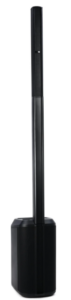
The other name that comes up constantly is the Bose L1 Pro8, which runs about $1,499 at full retail through Sweetwater, though American Songwriter’s review noted street prices closer to $1,199. Bose’s own product page describes a C-shaped line array featuring 8 articulated 2 inch neodymium drivers giving wide horizontal spread, and the design philosophy behind it is worth knowing: Sound on Sound noted that Bose envisions each musician having their own column, with that column also serving as a monitor . That’s a real difference from the two-speaker approach. Instead of a separate monitor wedge fighting feedback with your vocal mic, the column itself, positioned behind and above you, does double duty as your own sound reference.
So here’s how I’d actually decide. If you play a lot of outdoor gigs, farmers markets, patios, house concerts without reliable power, get the battery-powered column, the EON ONE MK2 is the one I know best and trust. If you play mostly indoor rooms with outlets and want the cleanest possible one-box setup with a built-in monitor function, the L1 Pro8 is worth the extra money. If you’re still building your rig and might add a second vocalist or a duo partner down the road, stick with separate powered speakers on stands, because that setup scales in a way a single column can’t. But if it’s just you, a guitar, and a room to fill evenly, a column array will save you time at every single gig, and that adds up faster than people expect.